
Infrared Thermometer – How To Use Header Temperatures For Diagnosis
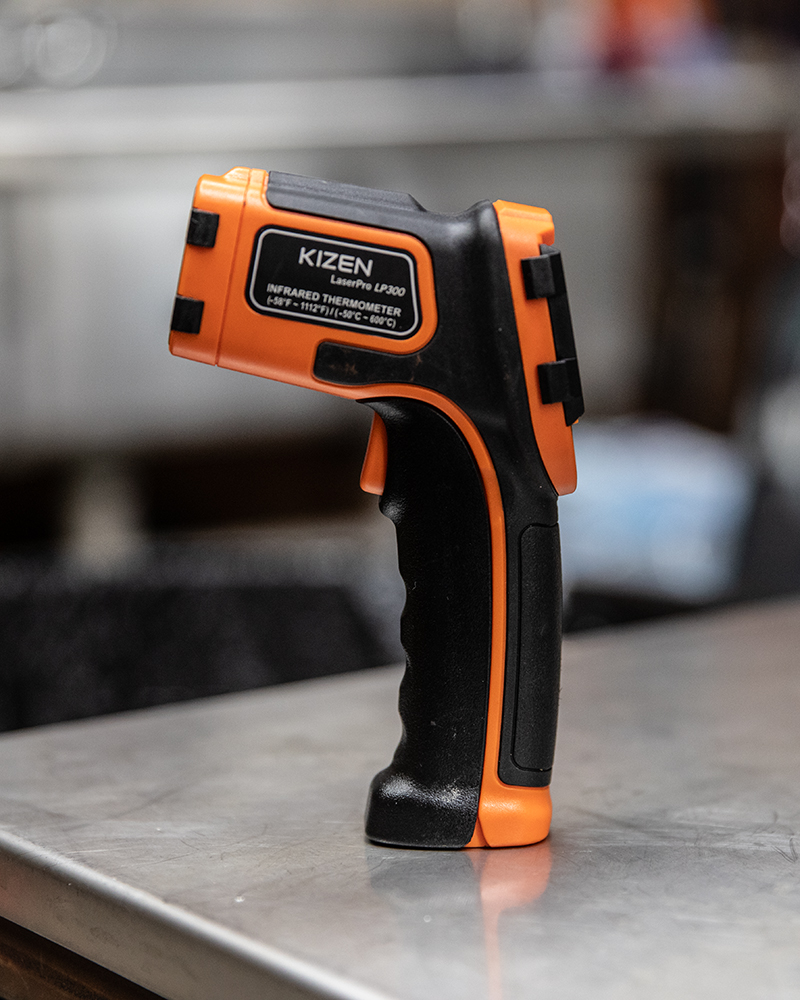
What Is an Infrared Thermometer?
While it goes by many different names—such as temp gun, heat gun, or laser thermometer—one of the best tools for diagnosing multi-cylinder vehicles is an infrared thermometer. Although the name may suggest a hefty price tag, these tools are actually very inexpensive. You can find them for as little as $10USD, and they’re worth their weight in gold. They’re available at almost any automotive or hardware store.
CLICK HERE TO BUY ONE ON ONLINE
⸻
How to Use an Infrared Thermometer
Alright, let’s get to the juicy bit! An infrared thermometer is a very simple device. Put simply, you point it at an object, apply the trigger, ensure the laser is on the area you want to measure, and read the screen to see the temperature of that object.
Keep in mind that the farther you are from your target, the less accurate the thermometer becomes. Different materials can also cause variances. For our use case, chrome can scatter the laser and cause inaccurate readings. When taking temperatures on chrome header pipes, we recommend putting a thumb-sized dot of black paint or using a black marker on each pipe about an inch below the muffler collars to avoid this issue.
⸻
How to Use a Temp Gun for Motorcycle Diagnosis
Alright, let’s get your bike warmed up and put this tool to use. From about 6–8 inches away, point and shoot your header pipes about an inch below the muffler collars. It’s good practice to use the forks to brace your hand while taking temperature measurements.
After taking each temperature, write the results down in a physical or digital notebook. Be sure to write the temperature and the corresponding header number. For reference, cylinder one is the far-left cylinder while sitting on the motorcycle seat, cylinder two is to the right of that, and so on.
⸻
What These Temperatures Tell You About Your Murray’s Carbs Setup
Not all temperature guns are created equally. Temperatures will vary from temp gun to temp gun. The absolute temperature value is not what we’re looking for—we’re focused on inconsistencies.
Let’s use a 4-cylinder motorcycle as an example. Murray’s Carburetor Kits supply fuel and air using 2 carburetors. The right carburetor supplies cylinders 1 and 2, while the left carburetor supplies cylinders 3 and 4. Your motorcycle’s electrical system supplies power to cylinders 1 and 4 via the left coil and cylinders 2 and 3 via the right coil.
If all cylinder temperatures are the same, that’s great. However, if one cylinder is cooler than the other 3 by more than 20 degrees, we know there’s a problem with that cylinder. This could be caused by low compression, a stuck valve, little or no spark, and similar issues.
If cylinders 1 and 4 are hotter or cooler by more than 20 degrees compared to cylinders 3 and 4, it’s likely your motorcycle has an electrical issue. This could involve the ignitor, coil, pickup, spark plug, spark plug wire, or timing. It could also be a combination of issues. In many cases, the coils are not receiving proper battery voltage, which should be right at or slightly above 12 volts.
If cylinders 1 and 2 are hotter or cooler than cylinders 3 and 4 by more than 20 degrees, there may be an issue with the carburetors.
⸻
Now that you know how to use a temperature gun, feel free to give us a call—we’re happy to help you with your diagnosis. Our email and phone number are listed below. Please don’t ever hesitate to reach out. The only bad question is the one you don’t ask.